Judge Scolds Alberta Municipality for “Sham” Hearing, Quashes Municipal Reserve Land Sale Resolution
In a scathing ruling described by lawyer Richard Harrison as the first of its kind, Alberta’s Court of King’s Bench quashed a Crowsnest Pass land-sale resolution and two bylaws, finding that selling municipal reserve land before the…
Video report: Judge Scolds Alberta Municipality for “Sham” Hearing, Quashes Municipal Reserve Land Sale Resolution
On November 23, 2023, a public hearing notice appeared on municipal reserve land in Blairmore, Alberta. The hearing concerned removing the land’s municipal reserve designation, a step needed before it could pass into private ownership.
But council had already agreed to sell the approximately 0.57-acre parcel for $20,000, its assessed value, without prior public notice or a hearing. The buyer proposed a tourism development on land designated for public purposes such as schools, parks and recreation.

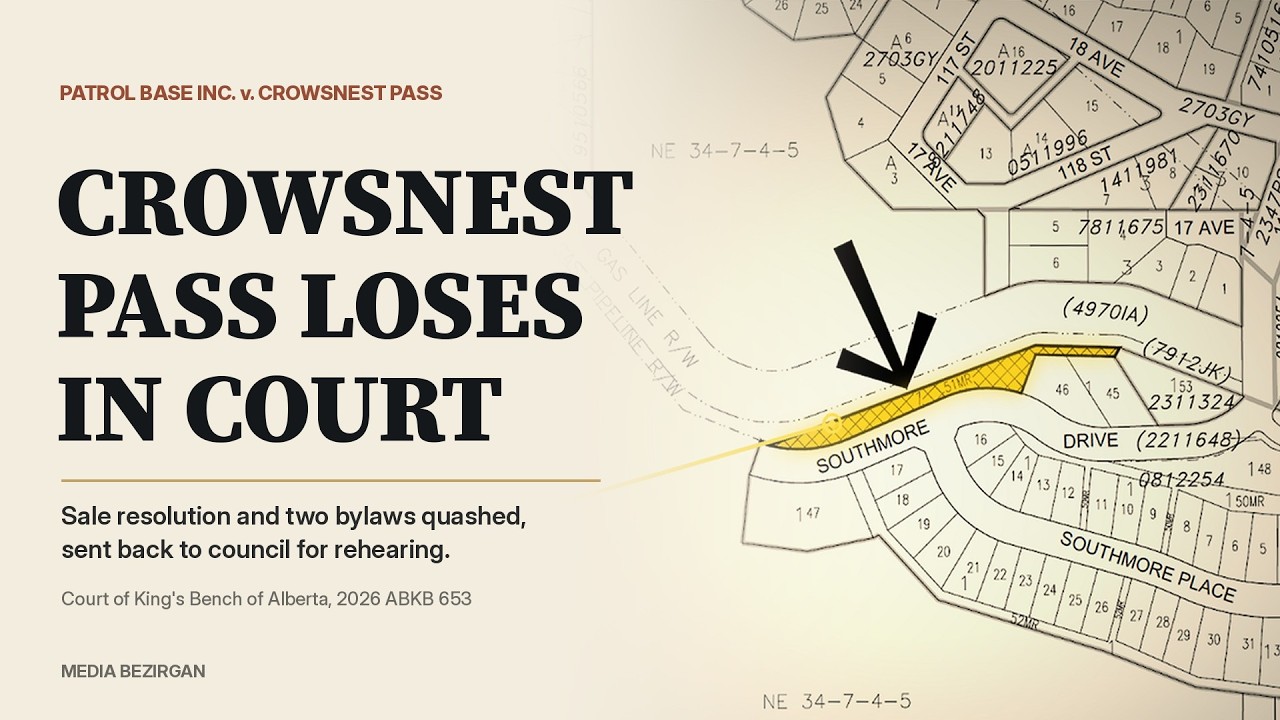
Alberta’s Court of King’s Bench found that council breached the Municipal Government Act’s procedural requirements and denied residents a meaningful opportunity to be heard by selling the land without a public hearing. The court quashed the sale resolution, Bylaw 1168, which removed the municipal reserve designation, and Bylaw 1197, which rezoned the property for tourism accommodation and recreation.
The question running through the decision is not simply whether people were allowed to attend a meeting or make a submission. It is whether their participation could still influence the decision, and whether they were given the same opportunity to address the proposal as those advancing it.
1. An offer accepted
The property was undeveloped, supporting trees and grasses. Its municipal-reserve designation mattered: the Municipal Government Act required an advertised public hearing before its sale.

Municipal Schedule A for proposed Bylaw 1197, reproduced from the previously sourced public-hearing material. Existing annotation marks the parcel. Municipality of Crowsnest Pass · Schedule A, proposed Bylaw 1197; existing Media Bezirgan annotation
The municipality had assessed the land at $20,000 in 2022. On September 25, 2023, a purchase application offered that amount. Council accepted the offer on October 17 through Resolution 17-2023-10-17.
The court found there had been no public notice or hearing before that vote.
The municipality disputed what the resolution meant. In its submission to the court, the transaction was only a conditional sale. Municipal reserve could not be privately owned; a binding sale could occur only after the designation was removed. Council, it argued, could still have defeated the proposal before the reserve-removal and rezoning bylaws passed.
Gaston examined the conditions, rather than accepting the label.
They required the purchaser to pay costs associated with removing the reserve designation, changing the land-use district, subdivision and the legal transaction. They also imposed completion and construction timelines. What they did not do was make the sale dependent on the outcome of public consultation.
In paragraph 32, the judge wrote:
“The Resolution adopted by Council did not include any conditions making the sale subject to, for instance, the outcome of a public hearing regarding the sale, the outcome of a public hearing regarding the removal of the MR designation, or subject to Council receiving input from the public for consideration.”
The difference was consequential. An obligation to pay for a process did not preserve council’s freedom to reconsider the sale after hearing from the public. The judge found the resolution reflected an agreement to sell municipal reserve, engaging the statutory hearing requirement.
“Adopting the Resolution prior to any public hearing or advertising was more than just technical non-compliance with the MGA,” Gaston wrote in paragraph 34. “It reflects a breach of both the public hearing and notice requirement regarding the sale of the Property.”
That reasoning raises a practical governance question: at the moment council accepted the offer, what provision actually left the public a meaningful role? The court found no condition securing one.
The $20,000 figure establishes the assessed value and the amount offered, not a judicial finding that the municipality sold below market value. The failure the judge identified was procedural: council committed itself without the required opportunity for public input.
2. A hearing with its outcome already constrained
The reserve-removal bylaw followed the sale resolution. Council gave Bylaw 1168 first reading on November 21, 2023. Notice followed, including the posting on the fence post. The public hearing was held on December 12, and the bylaw passed.
There was, in other words, notice and a hearing. Neither repaired the earlier commitment.

Already built. How much could taxpayers owe the developer? Media Bezirgan report graphic. Purchase agreement, clause 18.2.
The judge’s reasoning explains why timing was not merely a technical detail. Council had agreed to sell land that a private purchaser could not own while it remained municipal reserve. To fulfil that agreement, the reserve designation had to go. A hearing held within those constraints was not the open consideration residents could reasonably expect.
“They reasonably and properly expected that their concerns would be heard and considered by the decision maker,” the judge wrote in paragraph 41.
Instead, the court found, council’s earlier sale had committed it to removing the designation. The problem was not that residents had failed to put their views forcefully enough. It was that council had already undertaken a transaction requiring a particular result.
The conclusion in paragraph 43 was direct:
“Selling the property prior to the holding of the public hearing to remove its municipal reserve designation resulted in a sham of the public hearing, a required step under the MGA, which could not reasonably afford any members of the public an opportunity to have any concerns meaningfully heard or considered. Bylaw 1168 must be quashed for breach of procedural fairness.”

Paragraph 43 explains why the reserve-removal hearing could not offer meaningful public input after council’s prior commitment to sell.
The word “sham” was the judge’s description of that hearing’s inability to provide meaningful participation. It was not a finding of corruption or wrongdoing by the buyer.
The broader issue is readily understood outside a planning office. A hearing is supposed to inform a decision. If the decision-maker has already made a commitment that requires a particular outcome, inviting people to speak afterwards does not necessarily give them the opportunity the law promised.
For future sales, the relevant safeguard is not simply another date in the council calendar. It is whether the process leaves council genuinely able to consider what it hears before it commits.
3. The development residents could not discuss
Patrol Base applied for judicial review of the resolution and reserve-removal bylaw on February 1, 2024. Council subsequently pursued the rezoning needed for the resort.
Bylaw 1197 received first reading on July 9, 2024. The court records website and mailed notice, followed by newspaper advertisements on July 31 and August 7. The rezoning hearing took place on August 27, and council passed the bylaw that day.
Contemporaneous reporting shows what was at stake for neighbours. In an August 27 Lethbridge Herald article, Marilyn Bigcharles described concerns about traffic and noise from nightly rentals. She also recalled the earlier reserve-removal meeting.
“In the past meeting when they removed the Municipal Reserve status, they dismissed all our arguments against it, they said the development office will take care of them,” she told the newspaper.
The same article reported the developer’s case for the project. It quoted a letter from Tanrock Homes partner and construction manager Tanner Murphy: “Rezoning the land to UTAR will enable Tanrock Homes to develop ‘The Village,’ a mini home resort that aligns with the municipality’s tourism and economic development goals.”
Those were competing views of the development’s consequences. They help explain why a distinction between discussing zoning and discussing the development itself mattered.

The council at the time, 2021 to 2025 term. Not the current council. Photo: Municipality of Crowsnest Pass
Gaston’s examination of the certified proceedings found that the mayor repeatedly directed members of the public to restrict their submissions to rezoning. They were cautioned not to speak about concerns or issues with the proposed development underlying it.
Council already knew what development was contemplated. The rezoning application specifically identified an urban resort. Administration acknowledged the difficulty of discussing the rezoning without discussing the project for which it was sought.
The municipality had its own procedural bylaw describing what participants could expect. As the judgment explains, administration would begin with an introduction and brief overview, members of the public would speak, and councillors could ask questions. Its restriction on the subject matter of submissions was that speakers address matters within council’s jurisdiction.
The proposed development was squarely connected to the decision before council. The court was not being asked to create an unrestricted public forum on unrelated grievances; it was considering whether people could discuss the project that prompted the requested change.
Yet after the public’s submissions had been restricted, the purchaser and administration were permitted to address the development’s merits and purported benefits.

Justice M.R. Gaston Court of King's Bench of Alberta Photo: Osler
Public input in this context is a substantive right.
There was no basis for the Respondent to limit public submissions to the issue of rezoning and refuse to hear any submissions on the proposed development.
The resulting unfairness was not an abstract concern. It affected what residents could put before the people deciding whether the land-use rules should change. Benefits could be explained; concerns about the same proposal had been placed outside the public’s permitted discussion.
In paragraph 59, the judge found the applicant and other members of the public “were denied the opportunity to be fairly and meaningfully heard” on the underlying development and the resort land use.
Patrol Base challenged Bylaw 1197 on October 25, 2024. That bylaw, too, would be quashed.
4. What the judge did, and did not, find unfair
Both parties agreed Patrol Base was owed procedural fairness. The judge considered the nature of the decisions, the governing legislation, their importance to those affected and the expectations created by the process. The analysis was not a vote on whether a resort was desirable. It tested whether the municipality’s procedure met the obligations attached to its decisions.
After the hearing closed, council reopened it to let the purchaser speak. Gaston found that step was permissible.
“In my view, reopening the meeting mere minutes after it was closed to allow Mr. Fulkerth to speak was within the discretion of the Respondent and was not a breach of procedural fairness,” the judge wrote in paragraph 51.
Administration also made submissions at the end of the hearing, rather than simply answering council’s questions. Gaston found that sequence ran contrary to the procedural bylaw and the public’s reasonable expectations. But it was not, on its own, sufficiently unfair to invalidate the bylaw. Advising people at the outset that administration would speak last might have addressed that concern.
The more serious failure was unequal participation: limiting what the public could discuss while allowing the purchaser and administration to speak at length about those very matters.
Gaston considered that conduct alongside the original sale and the reserve-removal hearing. In paragraph 61, applying the test from an earlier appellate case, the judge found the cumulative process was “so devoid of the appearance of fairness that the administration of justice [is] brought into disrepute.”
The passage describes a legal test for invalidating the process, not a finding of criminal misconduct.
5. The court case continued. So did the project’s approvals.
The municipal decisions and the development-permit process were separate proceedings, with different outcomes.

A community aerial from Media Bezirgan’s Crowsnest Pass report. It provides geographic context; the disputed parcel is not identified in this frame. Media Bezirgan · frame from report
A December 2024 purchase agreement names the municipality as seller and Tanrock Homes Ltd. as buyer. It acknowledges Patrol Base’s court application. The price is $20,000, excluding GST.
The Chinook Intermunicipal Subdivision and Development Appeal Board’s decision records approval of a development permit on April 24, 2025. On July 8, 2025, the board denied Patrol Base’s appeal and upheld the permit subject to revised conditions. That permit outcome was not the later judicial-review outcome.
The court heard Patrol Base’s case on September 16, 2025. The reasons were filed almost a year later, on September 15, 2026.
Richard Harrison, the lawyer representing Patrol Base Inc., told Media Bezirgan in a written response that development had progressed while the judicial review was underway.
The operative court order is brief. In paragraph 62, Gaston wrote:
“In conclusion, the Resolution, Bylaw 1168 and Bylaw 1197 are quashed, and these matters are remitted to the Respondent for rehearing.”

The court’s operative order quashes three decisions and returns the matters for rehearing.
Harrison described the significance for his client in broader practical terms:

Richard Harrison Lawyer for Patrol Base Inc. Photo: Wilson Laycraft
The most significant part of the decision for my client is that it voids the municipality’s process, thereby requiring the municipality to reverse the sale of the property.
He said the land would be redesignated municipal reserve and return to municipal ownership.
6. The agreement that anticipated a court loss
Clause 18.2 of the purchase agreement, supplied to Media Bezirgan by Harrison, expressly identifies Patrol Base’s litigation. The possibility of an adverse ruling was not absent from the contract: the parties wrote down what would happen if its specified condition arose.
The clause provides that if a court declares the agreement void, or makes a ruling preventing the buyer from proceeding with its planned development, the municipality must repurchase the property for the purchase price and indemnify the buyer for specified costs.
Those are two distinct commitments. Repurchase would return the purchase price. The indemnity could cover additional reasonable costs incurred directly in developing the property, limited to planning and design, permits and fees, employee time and construction.
The agreement also specifies legal costs associated with completing the transaction, restoring title to the municipality and enforcing the indemnity.
Harrison identified compensation as an unresolved issue, not a settled award.
“The key issue is how the landowner will be compensated or if the landowner is entitled to compensation,” he wrote, directing attention to clause 18.2.
He also expressed a legal opinion about the agreement itself:
“I believe the entire agreement is void because the municipality never had the jurisdiction to enter into the agreement, given the Court’s decision, but this is an issue as between the municipality and previous landowner.”
That is Harrison’s position, not an additional declaration in Gaston’s order. The judgment did not expressly void the signed agreement, determine that clause 18.2 had been triggered or fix compensation.
I also question why the municipality would enter into an agreement that contained clause 18.2. It placed a lot of risk onto the municipality that is now a potential liability, depending on the enforceability of the agreement.
The public-interest questions follow from the document’s actual terms. Who authorized this allocation of risk? What reasons supported it while a judicial review was pending? What record shows how the potential exposure was assessed? If a claim is made, which costs would qualify, what evidence would establish they were reasonable, and how would the municipality report any amount paid?
7. The municipality’s response
On November 2, Media Bezirgan sought the municipality’s response to the judgment. The questions included why council accepted the offer before a public hearing, why public submissions had been restricted, when the matters would be reheard, who approved clause 18.2, its potential cost and spending on outside legal counsel.
Deputy Chief Administrative Officer Kristin Colucci replied on November 4:
“Although a decision has been issued in the judicial review, this remains an ongoing legal matter; accordingly, the Municipality is not in a position to comment at this time.”
The municipality did respond. Its statement did not answer those substantive questions or provide a timetable for rehearing.
Tanrock Homes had not responded to the newsroom’s invitation to comment as of its November 7 correspondence check. The court made no finding of wrongdoing by the buyer. The developer’s earlier arguments for the resort, reported in 2024, are separate from a response to the 2026 judgment.
In his October 28 written response, Harrison said: “No appeal was filed. I’ve had discussions with the municipality about next steps, but am not prepared to divulge how those will play out.”
Beyond the questions already sent, the findings point to a further test of accountability: what will change in the public process itself? A published explanation of hearing safeguards, the decisions requiring reconsideration and the steps for doing so would allow residents to assess the response against the judgment.
A financial account would answer a different set of questions: what has the litigation cost, what contractual claim is asserted, if any, and what amount has actually been accepted or paid? Those categories should not be collapsed into a single speculative taxpayer bill.
The municipality’s position that the matter remains legal business is on the record. So are the court’s findings about how public business was conducted.
8. Other disputes, different legal questions
For Harrison, the importance of the ruling extends beyond this parcel.
It sets out that the process cannot be a rubber stamp and that municipalities are required to hear and consider the concerns from constituents.
He also emphasized the significance of the rezoning stage: “Once land is rezoned, a neighbour’s rights are critically limited, something most Albertans do not understand.”
Harrison also described why the reserve designation matters to people living nearby: “The sale of municipal reserve is an important issue for Albertans, particularly those who purchased property assuming that municipal reserve would remain undeveloped.”
Those expectations help explain the stakes of changing the land’s status.

Map data © OpenStreetMap contributors (ODbL). Pins are approximate.
For some Crowsnest Pass residents, the ruling speaks to concerns they have raised for years about whether council genuinely considers public input. In our September 2025 report, residents and a former councillor questioned provincial oversight of municipal decisions and why residents were left to pursue costly legal challenges.
Among them is Blairmore resident Mindy Pawluk. As we reported in October 2025, she began asking questions about the municipality’s conditional sale of approximately 68 acres beside the historic Old Sartoris dump site, near her home.
Pawluk welcomed Patrol Base’s legal victory but expressed frustration that affected residents had to fund litigation to seek justice. In her recent interview with Media Bezirgan, she said she hoped the ruling would influence how the newly elected council handles other land transactions.
“I hope this sets the precedent for this new council to review the process and to ensure that public participation is involved in these sales.”

The Sartoris lands. Map in Land and Property Rights Tribunal decision 2026 ABLPRT 207 (Mar. 23, 2026), p. 5.
It sets out that before anything happens, the municipality must hear from affected neighbours and members of the public. If there are other transactions that were made within the last 6 months that also did not follow the correct process in the legislation, then those transactions are vulnerable to judicial review.
9. What a second hearing must mean
The most consequential safeguard in the judgment is also the simplest to state: public input must have a real place in the decision.
That does not mean the largest crowd wins, every objection must be accepted or development can never proceed. Nor does a lawful process guarantee the outcome neighbours prefer. It means people affected by a proposal must have a fair opportunity to address its material issues and have their submissions considered before the decision is foreclosed.
The court’s ruling leaves questions that reach beyond this one parcel. Why did council agree to sell municipal reserve land at its assessed value before holding the required public hearing? Why were residents heard only after council had committed to the sale? And why have calls for stronger provincial oversight gone unresolved for so long?
Former Crowsnest Pass councillor William Kovach described his experience seeking help from Municipal Affairs in our 2025 reporting.

William Kovach, former Crowsnest Pass councillor, in Media Bezirgan’s September 2025 report. Media Bezirgan
“We were in conversation with municipal affairs,” he said. “They were all really good in the beginning, lots of nice letters. Then in the end we get a letter from the minister stating, well, you can change council out in October.”
“What's the use of having municipal affairs if they don't step in and check things?”
But changing council does not resolve the question of provincial responsibility.
Doreen Johnson, who was then running for council and now holds a seat, warned about the toll these disputes take on rural communities:

Doreen Johnson Media Bezirgan, 2025 report
“This is a problem that cannot be allowed to continue to rip apart our rural communities. We can't be hiring lawyers, we can't be fighting this, and if they empower the municipalities with the MGA, it's their duty to enact it and make sure it's working, but the province has written it and washed their hands of it.”
The Southmore ruling established that residents were denied the meaningful public participation the law required. Why should securing that right depend on someone having the money to take a municipality to court?
If the province turns a blind eye to violations of the Municipal Government Act in the Crowsnest Pass, what other Alberta municipalities are facing the same problems?

Related stories


Help cover legal risk, travel, and fees to obtain court and regulatory records.
Get our next investigation by email
We’ll email you when we publish. No spam; unsubscribe anytime.
Thanks, you’re on the list. We’ll email you when we publish.